

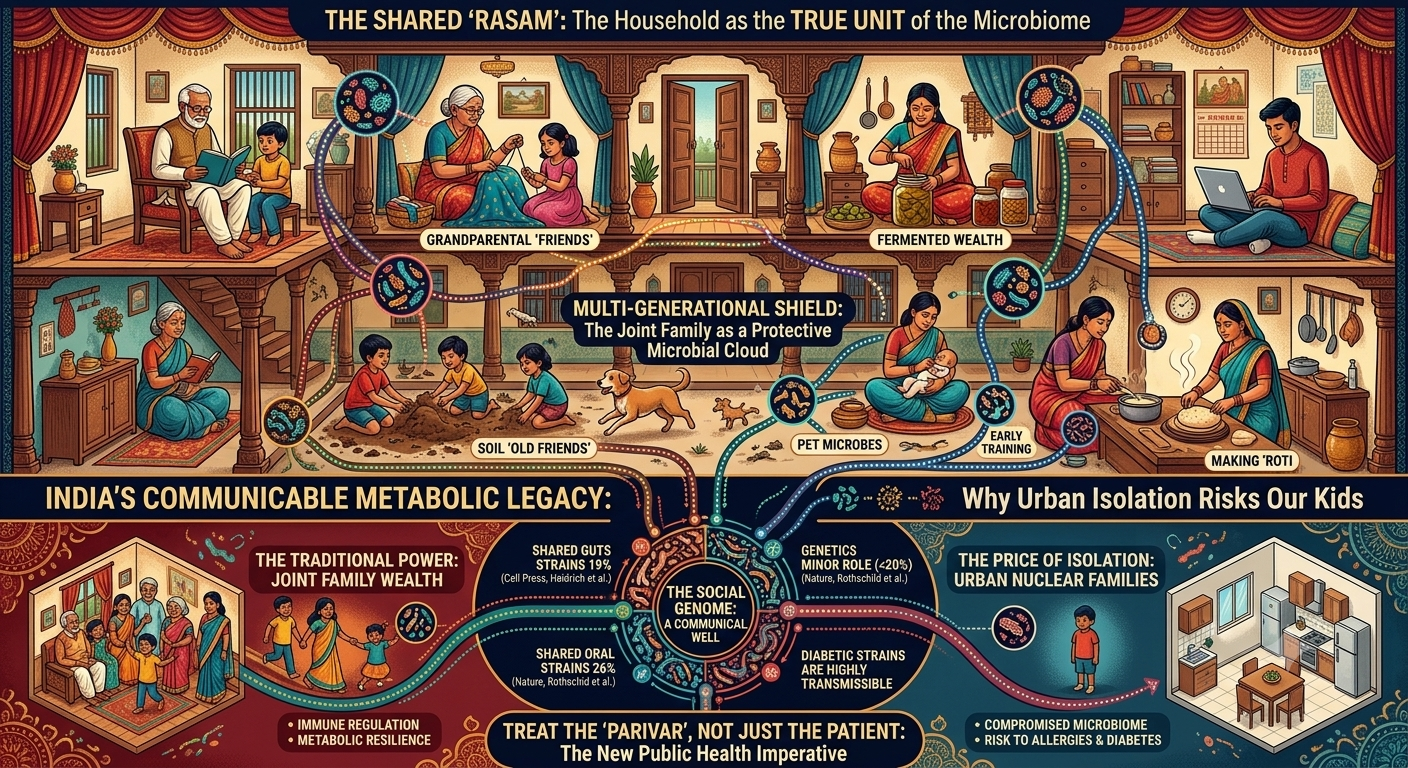
The Shared Rasam: Why the Indian Household is the True Unit of the Microbiome 🍲
We often treat our microbiome as a deeply personal biological fingerprint. The science tells a completely different story:
Your microbiome belongs to your household, not just you.
As India rapidly transitions from multi-generational joint families to isolated urban nuclear apartments, this biological shift has staggering implications — for our public health, our children's immunity, and our status as the diabetes capital of the world.
🧬 The Science: Environment > Genetics
Host genetics plays a minor role in shaping your gut microbiota. Genetic ancestry explained essentially none of it — instead, over 20% was driven by a shared home, diet, and lifestyle.
Cohabitants share an average of 19% of their gut strains and 26% of their oral strains. For people living in different homes, that shared percentage drops to nearly zero.
This is not a minor statistical footnote — it is a paradigm shift. The microbiome is not a solo instrument. It is an orchestra shaped by everyone in the room.
🛡️ The Joint Family Shield vs. Urban Isolation
Traditional Joint Families — Accidental Microbiome Masters
Traditional Indian joint families were accidental masters of microbial health. Growing up surrounded by grandparents, aunts, cousins, and pets meant children lived in a rich, diverse microbial cloud. Under the Old Friends hypothesis, this continuous multi-generational exposure naturally trained and regulated the developing immune system — building resilience no supplement can replicate.
The Sterile High-Rise — A Microbial Desert
Moving into sterile, hyper-sanitized high-rise apartments breaks this transversal supply chain of microbial diversity. When a child's only microbial exposure is two parents and a screen, the developing immune system is left without the environmental inputs it evolved to receive over millennia.
Raised in isolated nuclear bubbles, kids start life with a compromised, low-diversity microbiome — directly driving the skyrocketing rates of pediatric allergies, asthma, and early-onset metabolic dysfunction we see across India's urban centers today.
⚠️ The Critical Link to India's Diabetes Crisis
The 2026 data revealed something particularly alarming: the gut strains most highly transmissible between housemates are directly linked to biomarkers of Type 2 diabetes and poor cardiometabolic health.
In a small nuclear household, a compromised parental microbiome efficiently colonizes the children. If the shared environment is poor — stressful, sedentary, processed-food-dominated — the entire home becomes an incubator for metabolic disease, silently programming the next generation's health outcomes from infancy.
What This Means in Numbers
India already has over 101 million people with Type 2 diabetes. If household microbiome sharing is a key transmission vector for metabolic risk, then fixing individual patients without addressing the household environment is like bailing water from a sinking boat — without plugging the hole.
🏥 A New Healthcare Imperative: Treat the Parivar
For decades, medicine has treated the individual. But the data proves the microbiome is a communal well, constantly rewritten by the people we live and eat with.
If we want to reverse India's chronic disease epidemic, we must stop looking at patients in isolation. We must treat the household — the Parivar — as the true unit of clinical success.
"The healthiest prescription you can give a child may not be a supplement — it may be a dinner table."
This isn't about returning to the past for sentiment's sake. It's about understanding what the science is now unambiguously telling us: diversity of human contact, shared food cultures, and multi-generational cohabitation are biological necessities — not cultural luxuries.
💬 Let's Discuss
What are we no longer sharing in our modern lives, and how do we build back the "social genome" of our homes? From shared kitchens to community gardens — what solutions do you see? Let's discuss below! 👇